
Conclusion: The Sequential Electrical Stimulation with Intersperse technology is an effective treatment option for spine and joint pain across all ages. This provides insight into an effective non-invasive and non-pharmacological alternative to treating pain.
Conclusion: Our preliminary data suggest that TENS can be integrated into the long-term management of ocular pain with improvements in overall pain intensity.
Conclusions: The findings indicate that premodulated IFC, delivered via 2 large electrodes, may be clinically more effective than the traditional true IFC arrangement in terms of depth efficiency, torque production, and patient comfort.
Conclusions: At the 2-month follow-up interval, subjects in the treatment group had statistically significantly improved lumbar spine function compared with the control subjects. This effect continued during the last 4 months of the study after electrical stimulation had been discontinued. This suggests that electrical muscle stimulation can be an effective adjunctive treatment modality for nonacute low back pain. The effects of this combined therapy seem to last beyond the duration of electrical stimulation treatment.
Conclusion: The retrospective analysis supports the addition of Sequential Electrical Surface Stimulation to standard therapy following multilevel Selective Endoscopic Discectomy™.
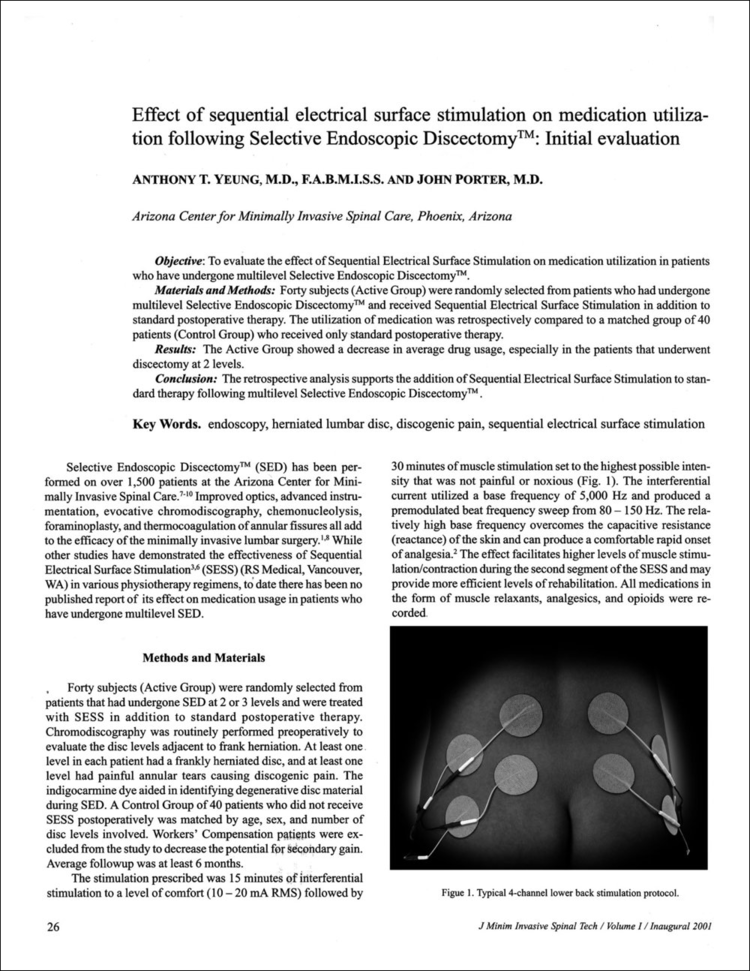
Conclusion: The Active Group showed a decrease in average drug usage, especially in the patients that underwent discectomy at 2 levels.
Conclusion: Results showed that patients in the Electrical Stimulation Group finished the three-week training regimen with higher percentages of both extension and flexion torque when compared with patients in the Voluntary Exercise Group (extension: t = 4.35, p < .05; flexion; t = 6.64, p < .05). These results indicate that patients in an electrical stimulation regimen can achieve higher individual thigh musculature strength gains than patients in a voluntary exercise regimen when simultaneous contraction of thigh muscles is prescribed during an early phase of postoperative rehabilitation.
Conclusion: Results showed that although both groups demonstrated increases in isometric strength of their quadriceps femoris muscles, training isometrically with ES produced a significantly greater increase (p < .01) than not training with ES. The relative strength improvement in Group 1 was positively and significantly correlated with training-contraction intensity and duration. The relative increase in isometric strength, using only ES, may be determined by the ability of the subjects to tolerate longer and more forceful contractions. Suggestions for further research and implications for the clinical use of ES for strength-training are discussed.
Conclusion: The electrical-stimulation and isometric-exercise groups had statistically significant increases in quadriceps femoris muscle torque when compared with the nonexercised controls (p less than .001). The data supported the use of this electronic stimulator as an appropriate device for strengthening skeletal muscle without voluntary effort.
Conclusion: To see whether the analgesia experienced by the chronic pain patients is mediated via links utilizing endorphins, the opiate antagonist naloxone was administered to these patients under double-blind conditions, saline being used as a placebo. We then found that 6 out of 10 patients receiving acupuncture-like stimulation but none out of 10 patients receiving high frequency stimulation of skin nerves, reported an inhibition of the stimulation-produced analgesia by naloxone. This indicates that the analgesia produced by acupuncture-like stimulation is mediated via mechanisms utilizing endorphins whereas the analgesia produced from high frequency stimulation of coarse cutaneous afferents is mediated via some other mechanism.

Conclusion: Compared to the control group, the test group showed reduced pain and increased function. The test group showed a greater decrease in the WOMAC pain subscale (P=0.002), function subscale (P=0.003) and stiffness subscale (P=0.004). More than 70% of the test group, compared to less than 50% of the control group, had at least a 20% reduction in the WOMAC pain subscale. When analyzing only patients who completed the study, the test group had a nominally significant greater decrease in overall pain VAS. No significant between-group differences were observed in incidence of adverse events.